
FAQ Index:
1. What’s a Polastax Instax Wide film holder?
2. Isn’t Instax film made for Fujifilm cameras? Why use Instax in a Polaroid camera?
3. What does “Polastax converted” mean?
4. Will the Polastax Instax Wide film holder work with my Polaroid pack film camera?
5. Pack film cameras used 3000 ISO and 75 ISO film, but Instax Wide is 800 ISO. How do I expose Instax properly in a Polaroid Land Camera?
6. Can you explain a bit more how the Polastax Instax Wide film holder’s dark slide works?
7. How do I load film into a Polastax Instax Wide film holder? How do I unload the film?
8. Wait, I have to develop the film myself outside of the camera? How am I supposed to do that?
9. I don’t own an Instax Wide camera and I can’t afford one of your dedicated Instax 210 developers—is there another way to develop my Instax film?
10. How do I take a picture with a Polaroid Land Camera and the Polastax Instax Wide film holder?
11. Wouldn’t it be easier to pay for a full Instax conversion of my Polaroid Land Camera?
12. Does the Polastax Instax Wide film holder work with Polaroid accessories like the Portrait Kit and Close-up Kit??
13. How do I make a double exposure using the Polastax Instax Wide film holder?
14. What kind of creative effects are possible with the Polastax Instax Wide film holder?
15. You claim that the Polaroid Land Cameras you have for sale are “Instax ready.” What does that mean?
16. You describe the Polaroid Land Cameras you have for sale as “refurbished.” What does that mean?
17. Which Polaroid Land Camera works best with the Polastax Instax Wide film holder?
18. Which Polastax converted Polaroid Land Camera should I buy?
19. Can I use the Polastax Instax Wide film holder with a medium format or large format camera?
20. Who created the Polastax Instax Wide film holder?
21. Okay, but someone on YouTube did this first, right?
22. What’s your refund policy?
23. Why “Polastax?”
24. Who owns this site?
25. Was AI used to make this site or any of the products for sale on this site?
1. What’s a Polastax Instax Wide film holder?
The Polastax Instax Wide film holder lets you use Instax Wide instant film in a prepared Polaroid pack film camera (typically the 100-400 series Polaroid Land Cameras). Developing is done outside of the camera, in either an Instax 210 or Polaroid 545i developer.
The Polastax Instax Wide film holder is analogous to a large format (4×5) film holder for large format film photography. To use each kind of holder, you load the holder with film in a darkroom or changing bag, shoot the film, and unload the film in a darkroom or changing bag. (If you don’t have a darkroom or a changing bag, a windowless bathroom or closet is sufficient for loading and unloading film.)
Like a large format film holder, the Polastax Instax Wide film holder comes with a dark slide that protects the loaded film from being exposed before it’s ready to be used, although the Polastax’s flexible dark slide works differently: it rolls from the front of the holder to the back, where the film sits.
In the same way that a large format (4×5) film holder will work in virtually any camera with an attached large format (4×5) back, the Polastax Instax Wide film holder will work with virtually any Polaroid pack film camera that’s been altered (converted) to use Polastax film holders.
2. Isn’t Instax film made for Fujifilm cameras? Why use Instax in a Polaroid camera?
There are many reasons to use Instax Wide in a Polaroid camera, chief among them being the option of employing a high quality glass lens instead of a plastic one, manual focus (not available in most Instax ready cameras), the ability to add bokeh (a blurred background) to an Instax photo, and the added creative tools that come with separate development of the film (masking and filtering, for instance).
3. What does “Polastax converted” mean?
To make the Polastax Instax Wide film holder fit in the back of a Polaroid pack film camera, we remove the film transport mechanism in the film compartment. Once this is done, the camera is Polastax converted.
See below for instructions on how to convert your Polaroid camera for use with Polastax Instax Wide film holders.
4. Will the Polastax Instax Wide film holder work with my Polaroid pack film camera?
To use the Polastax Instax Wide film holder in a Polaroid pack film camera, the camera must be converted to the Polastax format. Anyone can perform this conversion, no special tools or expertise are required.
It takes about five minutes to perform a Polastax conversion with a small flat head screwdriver and some lightproof tape. First, make sure that your camera is a pack film camera: if you have a 100-400 series Polaroid Land Camera, you’re all set; if not, verify that your Polaroid works with Polaroid pack film. (Note that the Polastax Instax Wide film holder will not work with integral film or Polaroid roll film cameras.)
Using the picture below as a guide, open the back of your Polaroid pack film camera and remove the screws and springs that secure the moveable film transport mechanism to the back. You’re taking out all of the parts of the back that move except for the hinged “stirrup” that holds the steel rollers.
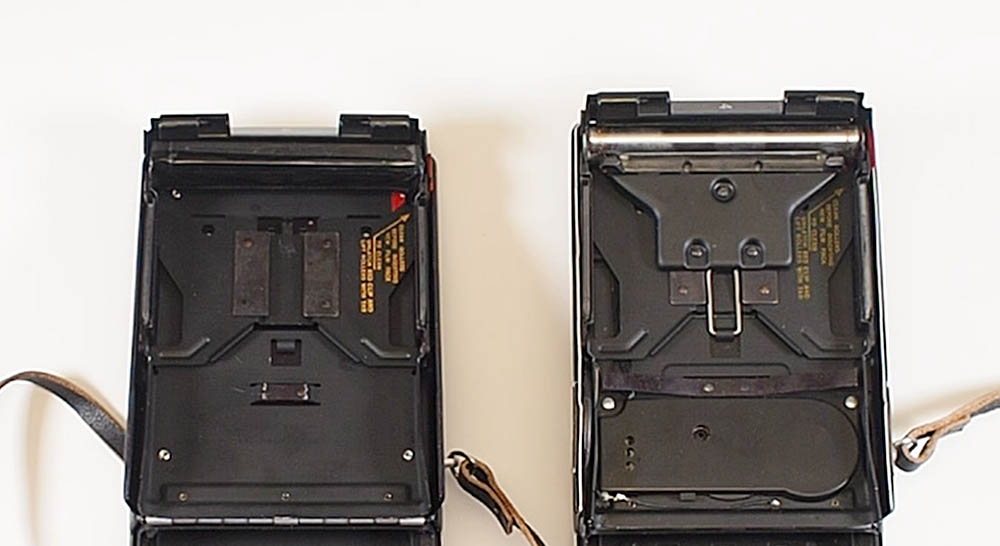
Once this is done, you have to patch the egress for the film to protect the holder from in camera light leaks. First, press the red tab on the top of the back to lift the rollers. Cut a piece of one millimeter plastic or cardstock to fit over the rollers; tape the plastic or cardstock over the rollers with the lightproof tape and use either packing or duct tape to secure the patch. Lower the roller assembly until it clicks into place.
That’s it! Now your Polaroid pack film camera is ready to use the Polastax Instax Wide film holder. Note that Polastax converted Polaroid Land Cameras will not work with pack film.
Own a 3d printer? Now you can print your own Polaroid Roller Light Guard (free download from Thingiverse).
5. Pack film cameras used 3000 ISO and 75 ISO film, but Instax Wide is 800 ISO. How do I expose Instax properly in a Polaroid Land Camera?
Our refurbished Polaroid Land Cameras come equipped with a specially designed light reducing cap that attaches to the meter housing on the front of the camera with Velcro. This meter cap reduces the amount of light the meter receives by two stops, making it possible to expose Instax film correctly on the camera’s 3000 ISO setting.
If you’re converting your own Polaroid pack film camera to use Polastax Instax Wide film holders, you can do the same thing by securing a 0.6 (2 stop) ND gel filter over the lightmeter to trick the camera into thinking that 800 ISO Instax film is rated at 3200 ISO. (The difference between 3000 and 3200 ISO is negligible and won’t affect film development.)
On a Polaroid Land Camera, different apertures are available at different ISO settings. If you’re only interested in shooting with the lens wide open (f8.8) or fully stopped down (f42-f56, depending on the camera model), you don’t need to use the lower ISO settings.
If you are shooting at one of the lower ISO settings, remove the meter cap (or your own 0.6 ND gel), store it in a safe place, and use a 40.5mm ND filter in our over the lens filter adapter—in combination with the Lighten / Darken lens adjustment—to get the correct exposure.
Our custom made 40.5mm filter adapter is included with the purchase of our refurbished Polaroid Land Cameras (it can also be purchased as a standalone item). To use the filter adapter, you unscrew the front part of the adapter, insert a 40.5mm filter with the threaded side of the filter facing away from the base of the adapter, and screw the front part of the adapter back on. With the filter inserted into the adapter, line up the cut out section of the base of the adapter with the Lighten / Darken index mark on the lens housing, centering the index mark in the middle of the cut out, and push the adapter down onto the lens’ outer ring. Note that the low profile filter adapter will not work in conjunction with Polaroid’s Portrait and Close up kit accessory lenses; to use these accessories, please purchase the high profile version of our filter adapter.
On the camera’s 75 ISO setting, with the meter cap or your 0.6 ND gel removed, a 0.9 (3 stop) 40.5mm filter in our filter adapter will reduce the amount of light passing through the lens and onto the film, effectively changing the in camera ISO from 800 to 100. (The difference between ISO 100 and 75 is neglible but can be compensated for with the Lighten / Darken setting on the lens itself.)
For cameras that come with 150 and 300 ISO settings, use a 0.6 (2 stop) or 0.3 (1 stop) 40.5mm filter, respectively, in our filter adapter along with a slight darkening of the Lighten / Darken setting to get the correct exposure.
6. Can you explain a bit more how the Polastax Instax Wide film holder’s dark slide works?
The Polastax Instax Wide film holder’s dark slide is a flexible, rolling dark slide that has three positions:
- Fully closed, film is protected; film cannot be inserted or removed.
- In camera, partly open (slide grip aligns with rear wall of holder), film is ready to be exposed but cannot be removed.
- Fully retracted (slide grip extends past the rear wall of the holder), film can be loaded or unloaded and is fully exposed to light.
7. How do I load film into a Polastax Instax Wide film holder? How do I unload the film?
Because the Polastax Instax Wide film holder uses a rolling dark slide—the first of its kind—it can take a little getting used to, so it’s advisable to spend some time opening and closing the slide with the holder empty to familiarize yourself with its use. When the holder is empty, remove the safety cap from the storage area built into the holder before you retract the slide.
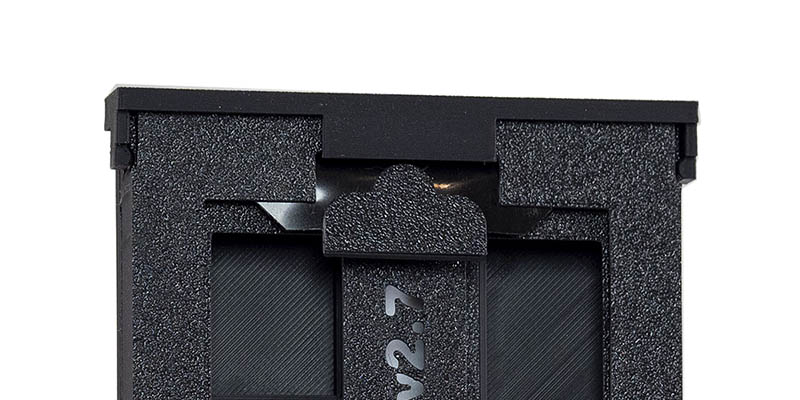
Note that you need to fully retract the dark slide to load or unload film in your Polastax Instax Wide film holder. The slide grip will extend out past the rear of the holder when it’s fully retracted, allowing you to insert or remove a sheet of film.
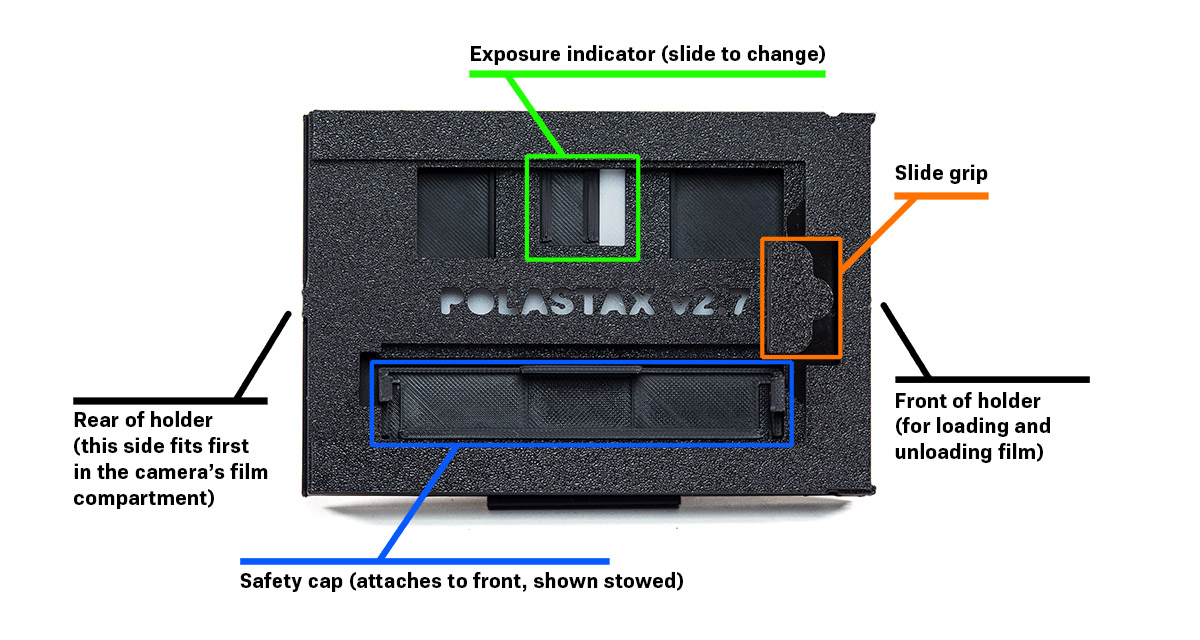
Loading Film
Always load film in a darkroom, changing bag, or fully darkened space.
To load a sheet of film, flip the holder over (the Polastax logo should be hidden) and point the open end of the holder up. Remove a sheet of Instax Wide from an open cartridge of Instax Wide film; the cartridge should be oriented with the film slot on the right and the open side of the cartridge facing you. Line up the film you removed with the open end of the holder; the pod should be on the right, and the Fujifilm logo will be visible. Gently feed the film into the slot in the open end of the holder; with your thumb on the unexposed middle part of the film, pull the film down until it is firmly seated.
When you’ve loaded a sheet of film into the holder, turn the holder over and use your thumb to roll the slide partly closed. Then use the slide grip to finish closing the slide.
With the slide closed, snap the safety cap in place: it fits over the open end of the holder and should sit flush. Your holder is ready to use!
Unloading Film
When unloading film, have an empty Instax Wide cartridge close by. Always unload film in a darkroom, changing bag, or fully darkened space.
Using your thumb, index finger, and middle finger, remove the safety cap and set it to one side. Fully retract the dark slide; with the holder’s open end facing up and the exposed film facing you, use your thumbs to push the film up and out of the holder. Set the holder down and grab your empty Instax Wide cartridge. Slide the film back into the cartridge, making sure that the pod side of the film is right next to the film exit slot. (If you put the film in the cartridge backwards, it will not develop properly.)
Close the Polastax’s dark slide (always store your empty holder with the slide closed), reset the exposure indicator, and stow the safety cap in the body of the Polastax Instax Wide film holder. You’re ready to develop your film! (See below.)
Tips
Some tips for loading and unloading film:
- Before your first attempt, watch our demonstration YouTube video.
- Using exposed sheets of film, practice loading and unloading with the lights on. Do this first with your eyes open, then practice several times with your eyes closed. Don’t try to load film until you feel comfortable with the process.
- Establish a routine: put the items you’re handling in roughly the same place and roughly the same orientation every time you load or unload.
- If you’re not using a changing bag, keep a lidded, lightproof box handy so you can stop if you get interrupted or need to take a break.
- Remember that Instax film is exposed from the back (the side of the film marked “Fujifilm). The back side of the film faces out from the holder.
- You don’t have to develop all of your film at once! You can let exposed Instax film sit for days, so if you only want to develop one sheet at a time, that’s okay.
8. Wait, I have to develop the film myself outside of the camera? How am I supposed to do that?
When instant film is ejected from an instant camera, a pod of developing chemicals is squeezed between two rollers and distributed across the emulsified portion of the film. Unfortunately, the orientation of Instax Wide’s developing pod makes it impossible to use the rollers in a Polaroid pack film camera because the pod is wider than the rollers. Thus we have to develop the film outside of the camera.
This is super easy to do, however, with an existing Fujifilm Instax 210 camera or an Instax 210 dedicated developer.
If you’re using an unmodified Instax 210 (or another Instax Wide camera), disable the flash and completely cover the lens before inserting an Instax Wide film cartridge containing your exposed film. Press the shutter release button to develop one sheet of film; repeat until the cartridge is empty.
If you’re using a rewired, dedicated Instax 210 developer (not a working camera), just load the cartridge and hold the shutter release button down until all of the sheets in your loaded cartridge have been ejected.
9. I don’t own an Instax Wide camera and I can’t afford one of your dedicated Instax 210 developers—is there another way to develop my Instax film?
There are Instax 210 developing alternatives, the most affordable being the use of a Polaroid 545 film holder.
Developing Instax Wide in a Polaroid 545 is a fully manual, hands on process that requires practice and patience. It can be challenging but is also lots of fun!
Here’s how it works: our Polaroid 545 holders come with a plastic sleeve that is the same width as a sheet of Instax Wide film. You put your undeveloped film in the joined side of the sleeve (you do this is in a changing bag or dark room, obviously) and feed the sleeved sheet of film into the unlocked holder. Be sure that the film’s developing pod is not adjacent to the joined seam of the sleeve; when you pull the sleeve out of the holder, the pod should be the first part of the film that slides between the rollers.
Swing the 545’s lever over to lock the holder’s rollers, grasp the protruding tongue of the sleeve with both hands, and pull slowly and evenly until the sleeved film has come all the way out of the 545. A good pull lasts between five to ten seconds and will spread developer over 90-95% of the film area (because of the width of the holder’s second roller, you will probably wind up with undeveloped artifacts along the very edges of your film).
10. How do I take a picture with a Polaroid Land Camera and the Polastax Instax Wide film holder?
First, make sure your Polastax converted Polaroid has two (2) AAA batteries loaded in the battery compartment.
Lift the focusing tab to extend the bellows.
Load the Polastax Instax Wide film holder into the film compartment. The Polastax logo should be right side up. Make sure the holder is fully seated.
Slide the dark slide open, pushing it to the left until it won’t move any more (use the tip of your finger or fingernail against the slide grip to get it under the leftmost lip of the compartment). Close the back of the camera; make sure it is fully closed.
Check your camera’s ISO and brightness setting (for aperture control). In general, regardless of ISO, you’ll need to set the brightness setting to Sunny in very bright conditions and to Cloudy/Flash when you’re indoors. If you’re shooting a sun facing scene or an area with deep shadows, adjust the Lighten / Darken wheel as needed.
Note that when composing and focusing your image, you need to ignore roughly the lower 15% of the viewfinder frame. Remember that Instax Wide has a landscape oriented pod (running from left to right) that will not be part of your picture. Frame accordingly!
If you’re using a Polaroid Land Camera with an integrated Zeiss viewfinder like the 250, you look through the same window to compose and focus. If you’re using a camera without an integrated viewfinder, you compose in one window and focus in the other.
Polaroid Land Cameras focus with a rangefinder. Pushing the focus tab with your finger, line up the details in the center of the finder window with the gold reflection superimposed over what you can see. When everything lines up, your image is in focus.
Cock the shutter and press the shutter release.
Open the back of the camera and slide the film holder’s exposure indicator to the left until the white “exposed” square is visible.
Using your right thumb, roll the dark slide of the Polastax Instax Wide film holder to the right. If you’re using your camera in very cold or very humid conditions, you may have to grip the leftmost notched parts of the slide with your first and third fingers to get it started. Finish closing the slide with the slide grip; make sure the slide is fully closed before you remove the holder from the camera.
If for some reason you can’t get the slide to fully close, don’t panic. Close the back of the camera, take it into your darkroom or put it in your changing bag, and remove the holder. Unload the film from the holder; with the holder outside the darkroom or changing bag, examine the dark slide to make sure it’s operating properly.
11. Wouldn’t it be easier to pay for a full Instax conversion of my Polaroid Land Camera?
Grafting the back of an Instax camera onto a hacked up Polaroid is one way of using Instax Wide film in a Polaroid camera, and if you want something that is “point and shoot,” this may be the best option for you.
There are many down sides to a “full” conversion, however. A fully Instax converted Polaroid camera weighs more, is bulky and harder to hold, and has less eye relief, since the viewfinder is slightly further away from your eye because of how far back the Instax part of the camera sits.
But chief among the disadvantages of the “full” conversion is the fact that you face some of the same limitations with a fully converted Polaroid / Instax Frankencamera that you do with a regular Instax camera because you’re still using an Instax cartridge in camera.
Shooting sheets of Instax Wide film individually in a Polastax Instax Wide film holder creates all sorts of opportunities for manipulating the light passing through the camera before it hits your film (see below). And keeping the developing separate means you can shoot under conditions that would be impossible with a fully converted Frankencamera.
Ever tried using Instax film in below freezing temperatures? With the Polastax Instax Wide film holder, you can! (Read our blog for more info on how to do this.)
12. Does the Polastax Instax Wide film holder work with Polaroid accessories like the Portrait Kit and Close-up Kit?
Although the PolaStax Instax Wide film holder will work Polaroid Portrait and Close-up Kits, please note that the holder creates a 1.9mm rear focal offset in camera which can affect what is in focus or out of focus particularly when you are using the Close-up Kit. To compensate, we recommend stopping the lens down (using it on the Outdoor / Sunny setting) and/or adjusting the focus by pulling the front standard slightly closer to you.
13. How do I make a double exposure using the Polastax Instax Wide film holder?
With the holder loaded and the dark slide pulled, you shoot your first exposure, shoot your second, and close the dark slide. That’s it!
14. What kind of creative effects are possible with the Polastax Instax Wide film holder?
Because the developing is separate, we can do just about anything we want to the film loaded in a Polastax Instax Wide film holder.
Masks and double exposures can create layered or composite photos. Using a set of “split view” masks, you can put yourself in the same frame twice; with our “tubular” mask or similar tools, you can combine parts of one brightly lit scene with parts of a separate shadowy scene in the same frame.
Transparent (acetate) filters can duplicate conventional photographic effects like the vignette or create new ones. Painting on transparent filters opens up all sort of creative opportunities, as does printing parts of existing images onto filters using an inkjet printer. Want to add a tint of gold to your photos? Or add “ghosts” to your Instax images? These things are super easy to do with our mask and filter system.
We offer a starter set of 3D printed masks that will work with our mask and filter trays (sold separately), but you can easily create your own masks or filters using our templates. Trays fit snugly under the Polastax Instax Wide film holder when it’s loaded into the camera, and they’re easy to swap out between exposures.
Mask and filter trays work best with Polaroid Land Cameras that do not have an electric timer built into the back of the camera.
Please note that the PolaStax Instax Wide film holder creates a 1.9mm rear focal offset which can affect what is in focus or out of focus when the holder is used in combination with mask and filter trays. In most cases, stopping down the lens (using it on the Outdoor / Sunny setting) will eliminate any error in focusing, but compensation may be necessary when shooting wide open (at f8.8).
15. You claim that the Polaroid Land Cameras you have for sale are “Instax ready.” What does that mean?
All of our refurbished, Polastax converted Polaroid Land Cameras are shutter tested. During shutter testing, we also make an effort to recalibrate each camera’s light meter. Some of the cameras we sell have meters that are effectively “zeroed out,” meaning that with our custom meter cap in place, they will expose Instax correctly with no Lighten / Darken adjustments at ISO 3000. Other cameras, in spite of being recalibrated, require a Lighten / Darken adjustment that we’ve measured during testing. This adjustment is recorded on a specially cut transparency that can be attached to the shutter housing, providing a reference point for proper exposure. (Why this matters: Polaroid light meters use simple CdS photoresistors; in direct light or deep shadow, you’ll need to use the Lighten / Darken adjustment to get a better picture. For converted cameras that aren’t “zeroed out,” the transparency makes it easier to do a quick reset after a Lighten / Darken adjustment.)
On the 3000 ISO setting, with the meter cap attached, all of our refurbished Polastax converted Polaroid Land Cameras will expose Instax Wide correctly even if you choose to use another type of Instax Wide holder other than the holder we sell.
16. You describe the Polaroid Land Cameras you have for sale as “refurbished.” What does that mean?
As mentioned above, all of our Polastax converted Polaroid Land Cameras are shutter tested, and we make an effort to recalibrate each camera’s light meter. After testing, we examine and clean the lens of each camera, examine the bellows for misfolds or separation, check the rangefinder for misalignment, clean the viewfinder, and replace the battery holder in the battery compartment with a AAA holder that works with two (2) AAA batteries.
17. Which Polaroid Land Camera works best with the Polastax Instax Wide film holder?
Any Polaroid Land Camera that used pack film will work with the Polastax Instax Wide film holder once it’s converted. Some Polaroid Land Cameras like the Polaroid 450, however, have an electronic timer built into the lid of the film compartment that can interfere with the use of mask and filter trays. If you are interested in employing creative effects with masks or filters, we recommend that you avoid cameras like the 450.
18. Which Polastax converted Polaroid Land Camera should I buy?
The Polaroid 250 is by far our favorite Polaroid pack film camera. It has a three element glass lens, an integrated Zeiss viewfinder with parallax correction (a necessity when you’re focusing up close with a rangefinder), a tripod socket, six apertures (aperture settings depend on the ISO), and is ruggedly constructed. It works great with the Polastax Instax Wide film holder in combination with our mask and filter trays. With that said, the 250 was manufactured from 1967 to 1969 and had a slightly less reliable lightmeter design than the Polaroid 450, which was manufactured between 1971 and 1974 and has the same lens and features as the 250. The 450 is also the only 100-400 series camera with electronic flash sync, or X sync. (As noted above, the 250 is preferable to the 450 if you’re planning to use our mask and filter trays with our Instax Wide film holders.)
19. Can I use the Polastax Instax Wide film holder with a medium format or large format camera?
With some modifications, Polaroid medium format and large format pack film adapters like the Polaroid 405 will work with the Polastax Instax Wide film holder when the film holder is paired with our specially designed “Polaroid 405 Safety Cap.” This means that you can use the Polastax Instax Wide film holder to shoot Instax Wide in a medium format or large format camera.
As of April 2026, we’ve tested the Polastax Instax Wide film holder in a modified Polaroid 405 large format adapter and a Polaroid pack film adapter for Hasselblad cameras.
Please see the blog for more info.
20. Who created the Polastax Instax Wide film holder?
Writer / photographer Chad Gayle is the inventor of the Polastax Instax Wide film holder. He spent over six months researching lightproof materials and lightproofing techniques during product development.
21. Okay, but someone on YouTube did this first, right?
Photographers have been putting Instax Wide film in Polaroid cameras for nearly as long as Instax Wide has been available. Many solutions have been proposed, from “full” conversions that hack apart two cameras and join together parts of each (usually an Instax Wide 210 and a Polaroid pack film camera) to bricks of Instax Wide-sized plastic married to a 3D printed dark slide.
The inventor of the Polastax Instax Wide film holder, Chad Gayle, didn’t invent the idea of using Instax Wide in a Polaroid camera, but he did invent the flexible, rolling dark slide that makes his Polastax Instax Wide film holder the most reliable way of using individual sheets of Instax film in a Polaroid pack film camera.
22. What’s your refund policy?
For new items with manufacturing defects and new or used items damaged during transit, return within two weeks of receipt for a full refund.
Film holders: Although we’ve made every effort to insure that our film holders are lightproof, given the fact that the holders have to be used in a certain fashion to work properly, we can’t guarantee the purchase of film holders against errors in use. In other words, while we think the Polastax Instax Wide film holder is reliable and easy to use, we don’t know how other people will employ it and under what conditions it will be employed. Therefore we can’t guarantee your purchase of the film holder against what you may consider to be an error during exposure. However, if problems develop with the holder’s dark slide (for instance: tears, bumps, bulges, or separation), please notify us immediately so that we can make arrangements for you to return the defective holder to us and receive a replacement.
Refurbished Polaroid cameras: Our Polastax converted Polaroid cameras are shutter tested, and we’ve tried our best to describe the condition of each camera in the product listing. With that being said, these are old cameras, and they are sold as is, with no guarantees or warrantees implied or granted.
Used Polaroid accessories: Used Polaroid accessories (such as the Polaroid Portrait Kit or the Self Timer) are sold as is, with no guarantees or warrantees implied or granted.
More details are available here.
23. Why “Polastax?”
“Polastax” is a portmanteau of Polaroid and Instax and is an easy way to identify Instax images made in a Polaroid camera.
24. Who owns this site?
Polastax.com is owned and operated by writer / photographer Chad Gayle.
25. Was AI used to make this site or any of the products for sale on this site?
No AI was used during the research and development of the Polastax Instax Wide film holder or associated 3D printed products.
No AI was used in the creation of this website.
No AI was used to produce, edit, or style this website’s content.
No AI was used by this site’s owner and operator and will not be used in any future endeavors associated with Polastax.com.
Have an opinion or a recommendation about using AI that isn’t “don’t use AI”? Please keep it to yourself, we’re not interested.